7 Best Fishing Weights For Various Depths For Every Angler
Master your depth control with our guide to the 7 best fishing weights. Learn which sinkers work best for every water column to improve your catch rate today.
Choosing the right fishing weight is the difference between feeling a subtle strike and dragging your lure aimlessly through the mud. Every depth and current presents a unique puzzle that requires a specific piece of gear to solve. Mastering these tools will transform how you interact with the water and significantly increase your time spent with a bent rod.
Disclosure: As an Amazon Associate, this site earns from qualifying purchases. Thank you!
Understanding Fishing Weight Density and Materials
The material of your weight dictates its physical size relative to its mass, which is a critical factor in how your rig behaves underwater. Lead has long been the industry standard due to its high density and low cost, allowing for a compact profile that cuts through the water column efficiently. However, it is soft and prone to deformation when hitting hard structure.
Tungsten has emerged as the premium alternative, offering significantly higher density than lead. Because tungsten is harder and denser, you can use a much smaller weight to achieve the same sink rate, which is a massive advantage when fishing in heavy cover or thick vegetation. While the price point is higher, the increased sensitivity and reduced snagging potential make it a worthy investment for serious anglers.
Steel and brass options exist as environmentally conscious alternatives, though they are less dense than lead or tungsten. These materials are bulkier for their weight, meaning they create more drag and can be affected more by current. Choosing between these materials requires balancing your budget against the specific demands of the environment you are fishing.
Water Gremlin Removable Split Shot for Shallows
When you are targeting panfish in the shallows or need to adjust your float rig on the fly, Water Gremlin split shots are the gold standard. Their "soft" lead construction allows you to crimp them onto your line with your fingers or light pliers without damaging the monofilament. They are incredibly easy to remove or reposition, making them perfect for those days when you need to experiment with your presentation depth.


These are an essential tool for any angler who values versatility and speed. If you are fishing clear, skinny water where a heavy weight would spook the fish, a small split shot provides just enough anchor to keep your bait in the strike zone. You should always have a variety pack in your tackle box; they are the most reliable way to fine-tune your rig in seconds.
Bullet Weights Steel Worm Weights for Weed Beds
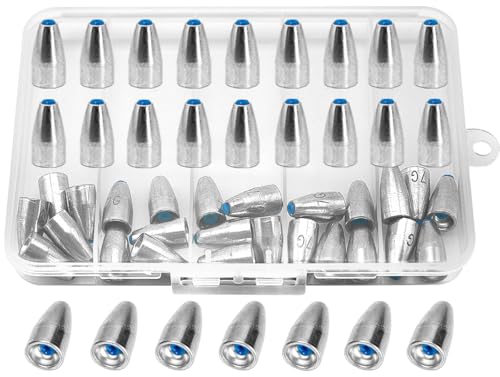
If you spend your time punching through thick lily pads or matted grass, Bullet Weights steel worm weights are your best friend. Their streamlined, conical shape is specifically designed to slide through dense vegetation without hanging up, allowing your soft plastic bait to penetrate deep into the cover where big bass hide. The steel construction is also a great choice if you are fishing in areas with strict lead-free regulations.
While they are slightly bulkier than tungsten equivalents, their ability to shed weeds is unmatched. They are the ideal choice for anglers who prefer power fishing in heavy cover and need a weight that won’t get bogged down in the salad. If you want to fish the thickest spots on the lake with confidence, these weights are the reliable, snag-resistant solution you need.
Eagle Claw Egg Sinkers for Versatile Rigging

The classic egg sinker remains a staple for a reason: its oval shape allows the line to slide freely through the center. This "slip-sinker" design is perfect for bait fishing, as it allows a fish to pick up your bait and swim away without feeling the resistance of the weight. It is the go-to choice for bottom fishing with live bait or cut bait in both freshwater and saltwater scenarios.
Because they are so versatile, they belong in every angler’s kit. Whether you are drifting for catfish or bottom-bouncing for walleye, the egg sinker provides a natural presentation that keeps your bait firmly on the bottom. If you prioritize a "live" presentation where the fish doesn’t immediately detect your terminal tackle, this is the weight you should be using.
Bass Pro Shops XPS Tungsten Weights for Depth

When you need to get to the bottom quickly in deep, clear water, tungsten is the only way to go. Bass Pro Shops XPS Tungsten weights are incredibly compact, which means they produce less drag and get your lure into the strike zone faster than any lead equivalent. The added hardness of the tungsten also transmits vibrations directly up your line, allowing you to "feel" the bottom composition with surgical precision.
These are a must-have for tournament anglers or anyone who fishes deep-water structure like rocky points or drop-offs. The smaller profile also makes them less likely to snag in rocky crevices compared to larger lead weights. If you are serious about deep-water tactics and need maximum sensitivity, these tungsten weights are an absolute game-changer.
Bank Sinkers for Heavy Current and Deep Water

Bank sinkers are designed for one purpose: to stay put. Their flattened, hexagonal shape is engineered to grip the bottom, preventing your rig from rolling away in moving water or steep drop-offs. If you are fishing a river with a strong current or trying to hold a position in deep, wind-swept lakes, this is the weight that will keep your line anchored.
They are rugged, functional, and unapologetically utilitarian. While they aren’t designed for finesse, they are essential for heavy-duty applications where staying stationary is the highest priority. If your local water features fast-moving channels or heavy winds, bank sinkers are the reliable workhorse that will keep your bait exactly where you want it.
Cannonball Sinkers for Deep Trolling Success
Trolling requires a weight that can pull your lure down to specific depths while minimizing line twist. Cannonball sinkers are the standard for deep-water trolling because their spherical shape tracks straight and true behind the boat. They provide the necessary downward force to keep your spoons or crankbaits at the target depth, even when you are moving at higher trolling speeds.
These are essential for open-water anglers targeting suspended fish in the middle of the water column. By pairing a cannonball sinker with a quality swivel, you can effectively manage your depth and prevent the dreaded line tangle. If you are planning a day on the lake trolling for salmon, trout, or walleye, a selection of cannonball sinkers is non-negotiable.
Top Brass Drop Shot Weights for Finesse Fishing
The drop shot rig is all about subtlety, and Top Brass weights are built to complement that finesse approach. Designed with a specialized clip that allows for quick depth adjustments, these weights let you change your distance from the bottom without retying your entire rig. The cylindrical or teardrop shapes are designed to minimize snags while keeping your bait perfectly suspended.

These weights are perfect for anglers who enjoy light-line fishing and need to keep their bait hovering just above the bottom. They are highly effective in pressured waters where fish are shy and require a delicate presentation. If you are looking to master the drop shot technique and want a weight that offers both performance and ease of use, these are the top-tier choice.
Selecting the Right Weight for Water Conditions
Choosing the right weight is a balancing act between the speed of the current, the depth of the water, and the type of cover you are fishing. A general rule of thumb is to use the lightest weight possible that still allows you to maintain contact with the bottom. This keeps your presentation natural and ensures you don’t miss the subtle "tick" of a bite.
- Shallow/Still Water: Use light split shot or small egg sinkers to minimize disturbance.
- Deep/Fast Water: Step up to heavy bank sinkers or tungsten to maintain bottom contact.
- Heavy Vegetation: Utilize streamlined bullet weights to punch through cover.
- Finesse Situations: Choose drop shot weights for precise, stationary presentations.
Always consider the wind as well. On a breezy day, you may need a slightly heavier weight than you would in calm conditions to keep a tight line and detect bites. Do not be afraid to swap weights throughout the day as the conditions or the fish’s mood change.
Maintaining Your Fishing Weight Tackle Storage
Proper storage of your weights is often overlooked, but it can save you significant time on the water. Invest in a dedicated, high-impact plastic tackle tray with adjustable dividers to keep your weights sorted by size and type. Mixing heavy lead weights with delicate terminal tackle can lead to damaged lures and frayed lines, so keep them in their own compartment.
Labeling your compartments by weight (e.g., 1/8 oz, 1/4 oz, 1/2 oz) will make your on-the-water adjustments much faster. Periodically check your weights for oxidation or sharp edges that could damage your line, especially if you use lead. A well-organized tackle box is a sign of a prepared angler, and it ensures that you spend more time fishing and less time digging through a disorganized mess.
Selecting the correct fishing weight is a foundational skill that bridges the gap between frustration and success. By understanding how density, shape, and material interact with the water, you gain total control over your presentation. Keep your kit organized, stay adaptable to the conditions, and you will find yourself landing more fish in every environment.