Flip Turns: 7 Techniques to Master for Lap Swimming
Unlock faster swim times with 7 flip turn techniques. Master your approach, rotation, push-off, and streamline to maximize speed and efficiency.
Nothing separates a good swimmer from a great one quite like a powerful, seamless flip turn. It’s the moment where a race can be won or lost, where precious seconds are either gained or squandered against the wall. Mastering this skill isn’t just about getting to the other side; it’s about transforming a necessary change of direction into a powerful weapon.
Disclosure: As an Amazon Associate, this site earns from qualifying purchases. Thank you!
Deconstructing the Perfect Flip Turn Sequence
A perfect flip turn is less a single action and more a chain reaction. Each step flows directly into the next, and a mistake in one part compromises the entire sequence. Think of it as a fluid, continuous motion: the approach, the tumble, the plant, the push-off, the glide, the breakout. It all happens in just a few seconds.
The goal is to carry your swimming momentum into the wall and then multiply it coming off the wall. Many swimmers incorrectly see the turn as a pause or a reset. A great turn is an accelerator. It’s where you convert horizontal momentum into rotational energy, then back into even greater horizontal momentum.
Breaking it down helps you drill each component individually before reassembling them into a single, explosive movement.
- Approach: Maintaining speed while sighting the wall.
- Tumble: A fast, compact somersault.
- Plant & Push: Feet hit the wall to create a powerful launchpad.
- Glide & Kick: A tight streamline followed by propulsive dolphin kicks.
- Breakout: Surfacing with maximum speed into your first stroke.
Sighting the Wall with Speedo Vanquisher 2.0s
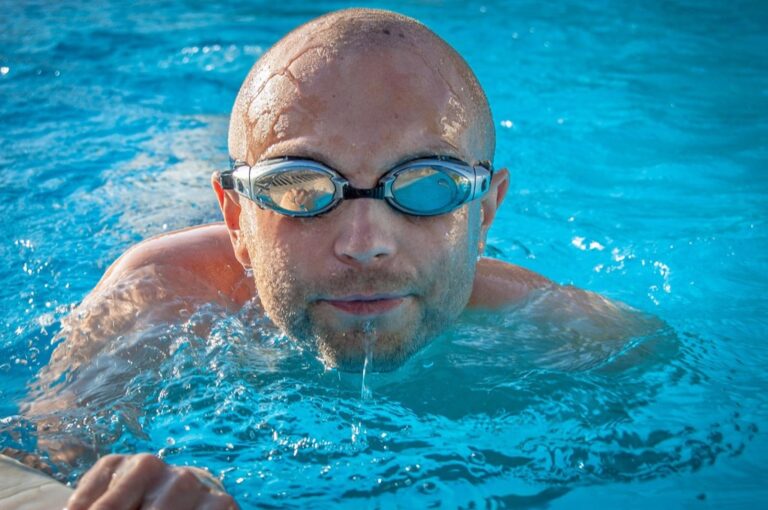
Your approach to the wall sets the entire turn up for success or failure. The biggest mistake is slowing down. You need to accelerate into the wall, trusting your timing and spatial awareness to know when to initiate the flip. This is where quality goggles, like the popular Speedo Vanquisher 2.0s with their wide peripheral view, become an essential tool, not just an accessory. They give you a clear, undistorted view of the black line on the pool floor and the "T" marker that signals the wall is approaching.
Don’t lift your head to look for the wall; that’s a classic momentum-killer. Instead, use the markings on the bottom of the pool. Most competitive pools have a line ending in a "T" about two meters from the wall. Once you see that "T," you know you’re one or two strokes away from your turn, depending on your height and stroke length. This allows you to keep your head down and your body aligned, driving forward with full power right until the last moment.
Executing a Fast, Compact and Symmetrical Tumble
The tumble itself must be aggressive and quick. A slow, lazy somersault bleeds speed and leaves you disoriented. The motion should be initiated by a powerful final pull with your arms, followed by tucking your chin hard to your chest. This is the trigger that starts the rotation.
Think "small and fast." As you tuck your chin, drive your knees toward your chest to create a tight ball. The smaller your body’s profile, the faster you will rotate, just like a figure skater pulling their arms in during a spin. Your hands should move from your final pull to a position by your sides, helping to guide the rotation and prepare for the streamlined position.
Symmetry is crucial. An uneven or lopsided flip will send you off the wall at an angle, forcing you to waste energy correcting your trajectory. The motion should be straight over the top, not off to one side. A great way to check this is to notice if you consistently push off crooked. If so, your tumble is likely the culprit. The goal is to land perfectly on your back, feet ready to hit the wall squarely.
Finally, the exhale. As you flip, you must exhale a steady stream of air through your nose. This prevents water from rushing up your sinuses—an uncomfortable and disorienting experience that can ruin the rest of the turn. This controlled exhale is non-negotiable for a comfortable, repeatable turn.
Planting Your Feet for an Explosive Push-Off
Where and how your feet hit the wall determines the power of your launch. As you complete your rotation onto your back, your feet should be aimed directly at the wall, slightly above your hips. You want your feet to be about shoulder-width apart, giving you a stable, powerful base to push from.
The ideal leg position is a roughly 90-degree bend at the knee when your feet make contact. If your legs are too straight, you have no leverage. If they’re tucked in too tightly, you’ve flipped too close to the wall and will have a cramped, weak push-off. This takes practice to get the distance just right, but that 90-degree angle is the sweet spot for generating maximum force.
Your feet should hit the wall and immediately explode off it. There is no pause. The wall is not a resting spot; it’s a springboard. The instant your toes touch, you should be driving off with all the power in your legs, transitioning that stored energy into forward propulsion.
Mastering the Streamlined Underwater Glide Phase
The moment you leave the wall is when you are moving at your fastest speed in the entire pool. The goal of the underwater phase is to preserve that speed for as long as possible. This is achieved with a perfect streamline, often called the "fifth stroke" for its importance in freestyle. Your hands should be locked one over the other, biceps squeezed tightly against your ears, and your core engaged to keep your body rigid and straight like a torpedo.
There’s a delicate balance here. You want to ride out the initial burst of speed from your push-off in a tight glide, but you don’t want to glide for so long that you start to decelerate. The transition from glide to dolphin kick should happen right as you feel your initial momentum begin to fade. For most swimmers, this is a glide of about one to two seconds before initiating the kicks.
Any break in your streamline will act like a parachute, creating drag and killing your speed. A stray hand, a bent elbow, or a relaxed core can undo all the power you generated from your push-off. The streamline is the single most important factor in carrying your speed off the wall. It’s free speed, and you can’t afford to waste it.
Using Powerful Dolphin Kicks to Maintain Momentum
Once your initial glide starts to slow, it’s time to turn on the engine: your dolphin kicks. These aren’t lazy little flutters. They should be powerful, undulating movements that originate from your core and flow all the way through your toes. Think of how a dolphin moves through the water—it’s a full-body motion, not just a knee bend.
The purpose of these kicks is to bridge the gap between your maximum push-off speed and your surface swimming speed, minimizing any drop-off in momentum. Your kicks should be fast and rhythmic, driving you forward while you remain in that tight streamline. Most elite swimmers will perform anywhere from three to six powerful kicks before starting their breakout.
Avoid the common mistake of kicking only from your knees. This creates a lot of turbulence but very little propulsion. Instead, focus on pressing your chest down and then driving your hips up and forward, creating a powerful "whip" effect that snaps through your legs and feet. This core-driven kick is what separates a decent underwater phase from a truly dominant one.
Timing Your Breakout and First Powerful Stroke
The breakout is the transition from underwater to surface swimming, and timing is everything. If you surface too early, you miss out on the low-drag advantage of being underwater. If you surface too late, you’ll have lost too much speed and oxygen. The sweet spot is breaking the surface just as your momentum from the underwater kicks begins to equal what your surface swimming speed would be.
As you approach the surface, initiate your first arm pull while you are still slightly submerged. This first pull should be deep, powerful, and connected to your hip rotation. It’s not a half-hearted effort; it’s an explosive stroke that helps pull your body up and forward, continuing the momentum you built off the wall. Your head should break the surface as your arm recovers forward, ready for the next stroke.
This first stroke is part of the turn, not separate from it. A perfect turn is useless if it’s followed by a weak breakout that brings you to a near-standstill. Practice linking your last dolphin kick directly into your first powerful pull for a seamless and speedy transition back into your race pace.
Breath Control: The Key to a Seamless Turn
Breath control is the unsung hero of a great flip turn. You simply cannot execute a fast, efficient turn if you are desperate for air. The rule is simple: do not breathe on the last stroke into the wall, and do not breathe on the first stroke out of the wall. Taking a breath in either of these moments will disrupt your body alignment, slow your rotation, and sabotage your breakout.
As mentioned earlier, you should be performing a steady, controlled exhale through your nose during the tumble itself. This serves the dual purpose of preventing water from entering your sinuses and ensuring you’ve emptied your lungs enough to take a quick, effective breath on your second or third stroke off the wall. Holding your breath entirely can create too much buoyancy, making the flip slower and more difficult.
Mastering this breathing pattern takes discipline. Your instincts will scream for air, but training your body to be comfortable with this short period of oxygen deprivation is essential for high-performance swimming. It ensures your turn remains a fluid, powerful, and uninterrupted sequence from start to finish.
Ultimately, mastering the flip turn is about weaving seven distinct skills into one fluid motion. Focus on one element at a time in practice, and soon you’ll find yourself not just changing direction, but launching into each new lap with more speed than you had before.