6 Best Wound Care Manuals For Aquatic Safety Instructors
Prepare for emergencies with our guide to the 6 best wound care manuals for aquatic safety instructors. Enhance your first aid skills and shop our top picks now.
A jagged coral scrape or a deep pool deck laceration can turn a serene day on the water into a high-stress medical emergency in seconds. Having the right reference material on hand ensures that panic never overrides proper protocol when seconds count. Mastering the art of wound management is a non-negotiable skill for anyone responsible for the safety of others in aquatic environments.
Disclosure: As an Amazon Associate, this site earns from qualifying purchases. Thank you!
Red Cross First Aid Manual: Best Overall Foundation
The Red Cross First Aid Manual remains the gold standard for instructors seeking a comprehensive, standardized approach to emergency care. Its structure aligns perfectly with the certification courses that most aquatic facilities require, making it an ideal companion for the classroom and the pool deck.
The beauty of this manual lies in its simplicity and clarity, providing step-by-step instructions that are easy to recall under pressure. It covers everything from basic wound cleaning to managing severe arterial bleeding with a focus on protocols recognized internationally.
For any aquatic instructor, this should be the foundational text on the bookshelf. It is the most reliable resource for standardizing care across a team of lifeguards who may have varying levels of experience.
NOLS Wilderness Medicine: Best for Remote Locations
When lifeguarding at a remote lake, a mountain-fed stream, or a surf spot far from urban emergency services, the NOLS Wilderness Medicine manual is essential. This guide anticipates the reality of “long-term” care where an ambulance is not minutes away, but potentially hours.
The content emphasizes improvisation and the management of infection in environments where traditional sterile supplies might be depleted. It teaches how to effectively irrigate wounds with limited water sources and dress injuries using gear already present in a backcountry kit.
This manual is the superior choice for open-water instructors who operate outside the bubble of city infrastructure. Its focus on environmental hazards—such as debris contamination—makes it uniquely suited for the realities of lake and river rescue.
AAOS Orange Book: Best for In-Depth Procedures
The American Academy of Orthopaedic Surgeons (AAOS) Emergency Care and Transportation of the Sick and Injured—often called the Orange Book—is for the instructor who wants to understand the “why” behind the “how.” It provides a deep dive into the physiological response to trauma, offering a level of clinical detail that others lack.
This resource is less about quick reference and more about comprehensive understanding. If a situation involves complex soft tissue injuries or potential underlying bone involvement, the detail found here is unmatched.
Instructors who serve as safety leads or facility managers benefit most from this text. It is an investment in professional development, providing the depth needed to train staff on complex decision-making during high-stakes incidents.
AHA BLS Provider Manual: Best for Core Responders
The American Heart Association (AHA) Basic Life Support (BLS) manual is the bedrock for any responder who needs to integrate wound care into a broader resuscitation effort. While heavily focused on cardiac and respiratory arrest, its sections on hemorrhage control are precise and authoritative.
It excels because it emphasizes the “chain of survival,” ensuring that wound management never distracts from airway and circulation priorities. The protocols are drilled into the reader through clear, algorithmic thinking that minimizes mental fatigue during an actual emergency.
This manual is mandatory for those who serve as the first point of contact in a medical crisis. It is the most effective tool for ensuring that life-saving skills remain sharp, repeatable, and compliant with current medical standards.
DAN First Aid for Divers: Best Marine-Specific Guide
Divers Alert Network (DAN) produces literature that is tailored specifically for the unique hazards of the marine environment. Their guides account for things that standard manuals often ignore, such as stings from jellyfish, coral cuts that resist healing, and the specific needs of individuals in pressurized or high-salt settings.
The protocols are built around the reality that salt water introduces different pathogens and recovery complications. It bridges the gap between basic first aid and the specialized knowledge required for marine-based recreational activities.
Any instructor working in ocean or saltwater environments should prioritize this resource. It acknowledges that the ocean is not just an environment, but a vector for specific types of trauma and infection.
U.S. Army First Aid Manual: Best No-Frills Option
Sometimes, technical jargon and flowery explanations serve as a distraction when a wound needs immediate attention. The U.S. Army First Aid Manual (FM 4-25.11) is crafted for high-stress, high-consequence environments where speed and efficiency are the only metrics of success.
The advice is blunt, tactical, and stripped of all extraneous information. It focuses on stop-the-bleed protocols, pressure point management, and field-expedient dressing techniques that work even in rain, wind, or low-light conditions.
This is the perfect manual for the instructor who values practical utility above all else. It is a reliable, no-nonsense guide for those who want their safety procedures to be as efficient as a military operation.
Choosing a Manual: Pool vs. Open-Water Needs
Selecting a manual depends heavily on the distance between the water’s edge and the nearest hospital. Pool instructors generally operate in a “sprint” mindset, where the goal is to stabilize the victim for a short period until paramedics arrive.
Conversely, open-water and wilderness instructors need a “marathon” mindset. Their manual must address long-term wound management, infection prevention in dirty water, and the psychological aspects of remote care.
- Pool Environment: Prioritize manuals focusing on standard, quick-response protocols like the Red Cross or AHA.
- Open-Water Environment: Prioritize manuals focusing on environmental hazards and extended care, such as NOLS or DAN.
Aquatic vs. Dry Land: Key Wound Care Differences
Wounds in aquatic settings are inherently more complex because water is an active carrier of bacteria and debris. Standard dry-land protocols often overlook the risks of vibrio or other water-borne pathogens that can turn a minor scrape into a systemic infection.
Aquatic wounds require aggressive irrigation with potable water rather than simple surface cleaning. Furthermore, the difficulty of maintaining a dry, sterile dressing on wet, wrinkled skin is a challenge that traditional manuals rarely address with enough detail.
Always assume that any wound occurring in water is potentially contaminated. Immediate, thorough flushing with clean, drinkable water must be the first step before applying any topical treatment or bandage.
How to Build a Waterproof First-Aid Kit
A waterproof manual is useless if the supplies inside the kit are ruined by humidity or submersion. Start with a hard-shell, gasket-sealed container that can survive a drop or a wave.
Inside, organize supplies into clear, vacuum-sealed bags labeled by function, such as “Bleeding Control” or “Irrigation.” This allows for immediate identification without needing to dump the contents of the kit onto the wet ground.
- Sealable Containers: Essential for protecting adhesive bandages and sterile dressings.
- Layering: Keep the manual at the top of the kit, inside a secondary zip-lock bag.
- Checklists: Include a laminated inventory list so missing items are identified during routine monthly inspections.
Keeping Your First Aid Skills & Manuals Current
Medical protocols evolve, and an outdated manual can be as dangerous as no manual at all. Commit to a yearly cycle of replacing or updating your primary reference materials, especially if new guidelines from the ILCOR (International Liaison Committee on Resuscitation) are released.
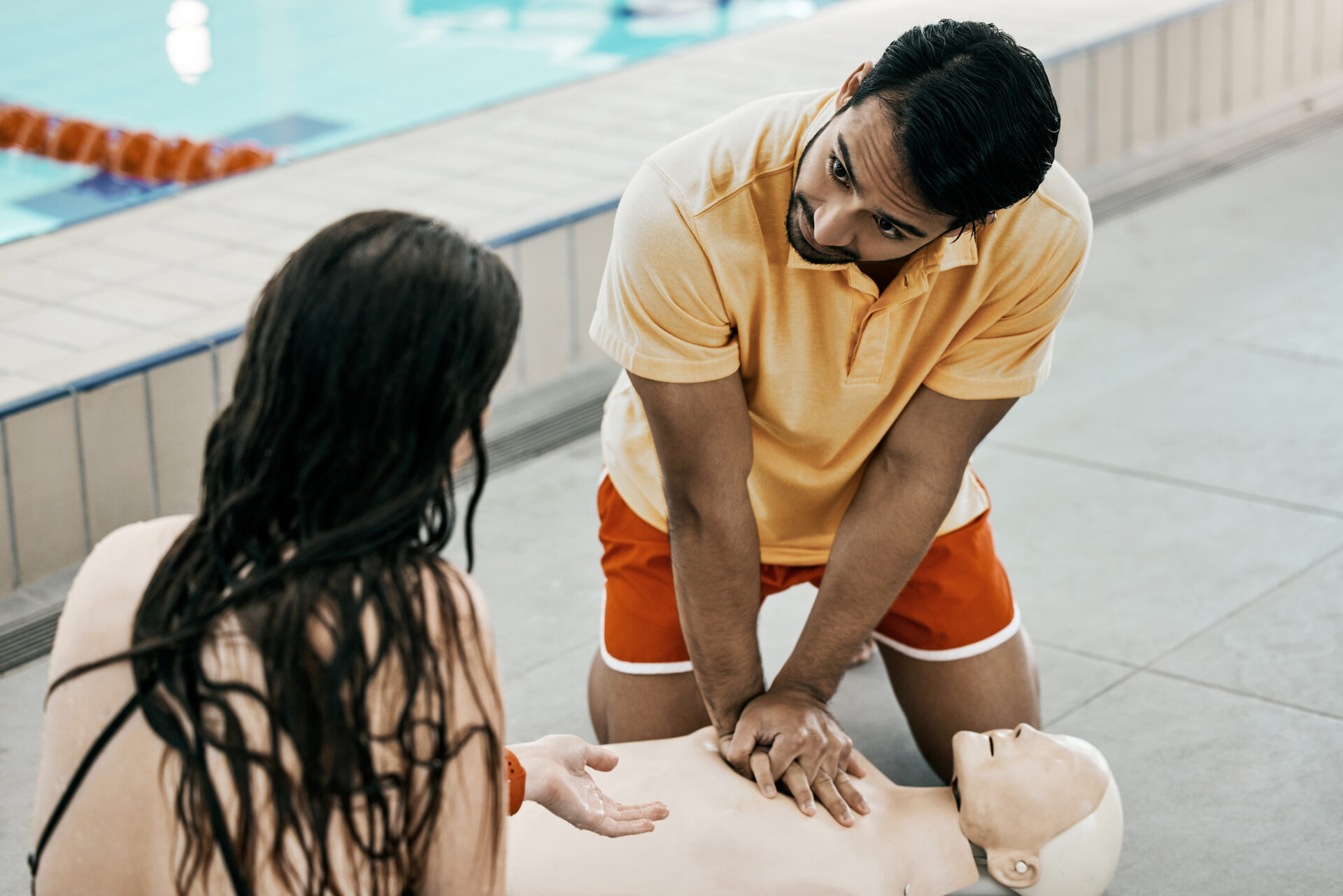
Beyond the books, hands-on practice is the only way to retain these skills. Host quarterly “scenario days” where instructors must perform wound care drills in realistic conditions—such as standing in the pool or in simulated high-wind conditions on a beach.
Manuals serve as the brain of your safety program, but your staff must be the muscle. Never let the knowledge reside only on the page; it must be ingrained through consistent, high-intensity training.
A well-prepared aquatic safety instructor is defined by the quality of their resources and the readiness of their team. By choosing the right manual for your specific environment, you provide a safer experience for every swimmer in your charge.