6 Ways To Incorporate Playtime Into Deep Water Lessons That Boost Safety
Boost deep water safety with structured play. Discover 6 engaging games designed to teach essential survival skills and build a swimmer’s confidence.
The moment a swimmer’s feet can no longer touch the bottom, their entire relationship with the water changes. Suddenly, staying afloat isn’t an option—it’s a necessity. This is precisely why introducing deep water skills through structured play is one of the most effective ways to build real, lasting safety.
Disclosure: As an Amazon Associate, this site earns from qualifying purchases. Thank you!
Why Play-Based Learning Excels in Deep Water
Deep water introduces a psychological barrier long before it presents a physical one. The fear of the unknown, of the space below, can cause swimmers to tense up, forget their skills, and panic. Play-based learning systematically dismantles this fear by reframing the challenge. Instead of focusing on the intimidating depth, the swimmer’s attention is on a fun, achievable goal.
This shift in focus is critical. When a child is trying to win a sculling race or retrieve a dive ring, they aren’t thinking about how deep the water is. They are instinctively using their breath control, kicking, and arm movements to accomplish a task. This process builds muscle memory and confidence in a low-pressure environment, making safety skills second nature rather than a source of anxiety.
The result is a swimmer who doesn’t just know how to tread water; they feel comfortable doing it. They learn to trust their body’s buoyancy and their own ability to stay in control. This ingrained confidence is the foundation of true water safety, preparing them to react calmly and effectively if they ever find themselves in deep water unexpectedly.
Treading Water Drills with a FINIS Kickboard
Build leg strength and improve your kick technique with the FINIS Standard Foam Kickboard. The comfortable EVA foam and simple shape provide a secure grip and effortless movement through the water.


Treading water is a non-negotiable survival skill, but drilling it endlessly can be monotonous and exhausting. A simple FINIS Kickboard can transform this chore into an engaging challenge. The board provides just enough support to build confidence while still requiring the swimmer to do the majority of the work.
Start with a game of “keep the kickboard dry.” The swimmer holds the board flat on the water’s surface with their hands and must use a strong eggbeater or flutter kick to keep the top of the board from getting wet. This encourages a powerful, efficient kick and vertical body position, the two most important components of treading water. It turns a static drill into a dynamic goal.
As they gain strength, you can introduce variations. Try having them tread water while holding the kickboard with only one hand, or balancing it on their head for a few seconds. These playful additions challenge their stability and coordination, teaching them how to adjust their body position to remain afloat. The goal isn’t just to stay up, but to learn how to move and adapt while vertical in the water.
Diving for Banzai Dive Rings and Torpedoes
Make pool time more fun with this six-pack of dive rings! The raised star pattern provides an easy grip, and the bright colors ensure visibility underwater.
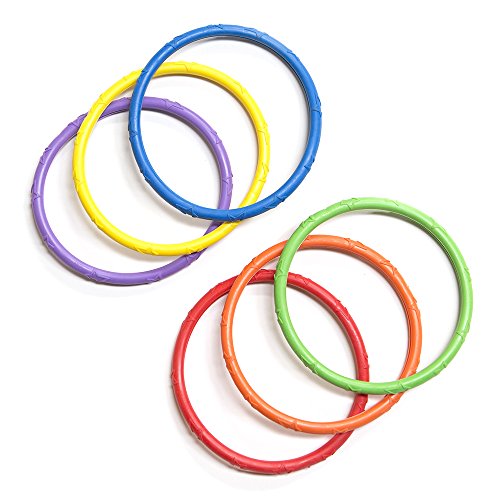
Nothing builds underwater confidence faster than retrieving objects from the pool floor. Banzai Dive Rings and Torpedoes are perfect tools for this because they are colorful, sink at a manageable speed, and are easy to grab. This activity directly teaches breath control, underwater navigation, and the ability to resurface calmly.
Begin in water that is just over the swimmer’s head, so the goal is challenging but not overwhelming. Have them take a deep breath, push off the wall, and glide down to retrieve one ring. This simple act teaches them to open their eyes underwater, equalize pressure in their ears, and manage their air supply. It’s a controlled, repeatable way to get comfortable with being fully submerged.
As their confidence grows, you can increase the depth or the number of objects. Scatter multiple rings and challenge them to collect as many as they can in one breath. Use torpedoes, which glide further, to encourage them to swim underwater to retrieve them. This progression builds lung capacity and spatial awareness, turning a simple game into a powerful safety lesson.
Rhythmic Bobbing for Breath Control Practice
One of the first things that happens during a water-related panic is the loss of breath control. Rhythmic bobbing is a foundational game that directly counters this by making proper breathing a fun, repetitive action. It’s the simple act of sinking down, blowing bubbles out through the nose, and pushing off the bottom to come up for a quick, efficient breath.
Turn it into a game by adding a rhythm or a song. Have swimmers bob up and down to the count of “one, two, three, BREATHE!” or while singing a simple tune like “Row, Row, Row Your Boat.” This makes the exercise feel less like a drill and more like a dance, encouraging a relaxed and natural breathing pattern.
This skill is directly transferable to real-world safety scenarios. If a swimmer is accidentally submerged by a wave or a splash, the muscle memory from rhythmic bobbing kicks in. Instead of inhaling water in a panic, their instinct will be to blow air out and push toward the surface for their next breath. It’s a simple game with profound safety implications.
Sculling Relays to Master In-Water Support
Sculling—the figure-eight motion your hands make to propel or support you in the water—is an essential skill for staying afloat with minimal effort. It’s the basis for treading water and maintaining a stable position. But “practicing sculling” sounds boring; “sculling relays” sound like fun.
Divide swimmers into teams and have them race across the deep end using only their hands for propulsion. They can be on their backs (head-first sculling) or on their stomachs with their head out of the water (feet-first sculling). The competitive nature of a relay encourages them to refine their sculling motion to be more powerful and efficient without even realizing it.
This game teaches swimmers how to “feel” the water and use it for support. They learn that small, consistent hand movements can keep their head above the surface, a crucial skill if they become tired. It demonstrates that they don’t need big, exhausting arm strokes to stay safe, building an understanding of energy conservation in the water.
Safe Deep Water Entries with “Follow the Leader”
How a person enters deep water is just as important as what they do once they’re in it. A game of “Follow the Leader” is the perfect way to practice various safe entries in a controlled and playful manner. It takes the fear out of jumping in and replaces it with a fun, social challenge.
The leader can demonstrate a variety of entries, progressing from simple to more complex:
- Seated entry: Sitting on the edge and sliding in feet-first.
- Pencil jump: Jumping in straight like a pencil, feet-first.
- Cannonball: A classic tuck jump that builds confidence with a big splash.
- Stride jump: A safety-oriented entry used when you need to keep your head up to watch something.
Each follower mimics the leader, getting comfortable with entering the water from different heights and in different body positions. Crucially, every entry is followed by turning around and swimming back to the wall. This reinforces the most important safety habit: always know your exit. It builds a complete sequence—enter, surface, orient, and return to safety.
Practicing Survival Floats and Back Floating
Floating is the ultimate energy-conservation skill in the water. However, holding a static survival or back float can be tedious for many swimmers. Turning it into a quiet challenge or a game of observation can make all the difference.
For the back float, challenge swimmers to become “starfish” or “logs” and see who can stay the most still for the longest time. Have them close their eyes and focus on their breathing, feeling how their lungs act as natural flotation devices. This meditative approach reduces anxiety and teaches them to trust the water to support them.
The survival float (also known as the “dead man’s float”) can be framed as “jellyfish” or “turtle” floating. Swimmers take a breath, put their face in the water, and let their limbs hang loosely, conserving massive amounts of energy. Challenge them to lift their head for a breath only when absolutely necessary. This teaches them that they can rest and breathe in open water for long periods without exhausting themselves by constantly treading water.
Turning Playtime into Lasting Water Confidence
Ultimately, every game and drill has the same underlying purpose: to build a swimmer’s intuitive understanding of how to work with the water, not against it. When a swimmer has spent hours playfully retrieving dive rings, they don’t panic when they drop their goggles in the deep end. After racing in sculling relays, they instinctively know how to use their hands to stay afloat if they get tired.
This transition from conscious thought to subconscious reaction is the hallmark of true water safety. Play accelerates this process by creating positive, memorable experiences. The joy of a successful cannonball or the pride of winning a relay race becomes linked with the skills used to achieve them.
These playful lessons build a foundation of confidence that extends far beyond the pool. A child who is comfortable and competent in the deep end is better prepared for the unpredictable nature of lakes, rivers, and oceans. They have learned not just to swim, but to think and react calmly in the water, a skill that will keep them safer for a lifetime.
By weaving these purposeful games into deep water instruction, we’re not just teaching strokes; we’re building resilient, confident, and safer swimmers who are prepared for a lifetime of responsible water recreation.