7 Tips For Overcoming Swim Anxiety to Build Water Confidence
Learn to conquer swim anxiety and build lasting water confidence with 7 proven tips, including breath control and gradual water acclimatization.
Standing at the edge of the water, you can feel the pull to jump in, but a knot of anxiety holds you back. This feeling is incredibly common, whether it stems from a past scare or a simple fear of the unknown. Overcoming this hesitation is about more than just learning to swim; it’s about unlocking a world of recreation, fitness, and life-saving skills.
Disclosure: As an Amazon Associate, this site earns from qualifying purchases. Thank you!
Understanding the Roots of Your Water Anxiety
Water anxiety often has a specific source. For many, it’s a negative childhood experience—being pushed in, getting caught in a current, or just struggling in a lesson that moved too fast. For others, it’s a more general fear of the unknown, a feeling of losing control in an element where you can’t breathe.
Identifying the trigger is the first step toward dismantling it. Is it the depth? The cold? The sensation of water covering your face? Naming the specific fear takes away some of its power and gives you a clear target to work on. You’re not just "afraid of water"; you’re anxious about a specific, manageable sensation or scenario.
This process is more about strategy than therapy. Acknowledging your fear allows you to create a plan that addresses it directly. Instead of avoiding the water, you can approach it with a new understanding of what you need to feel safe. This mental shift is foundational to building real, lasting confidence.
Start in Shallow Water to Build Familiarity
The pool’s shallow end is your training ground for confidence. Its greatest asset is simple: you can stand up at any time. This fundamental sense of control is crucial for calming the anxious mind.
Don’t just stand there; get comfortable with the water on your own terms. Sit on the steps and let the water lap over your legs. Walk around, feeling its resistance and support. Practice bobbing up and down, getting your shoulders, then your chin, then your whole head wet for just a second.
Each small, successful interaction sends a powerful message to your brain: I am in control here. This is a safe space. Rushing this stage is the most common mistake and the quickest way to reinforce fear. Spend as much time as you need in the shallow end until it feels less like a threat and more like a familiar environment.
Use Speedo Biofuse 2.0 Goggles for Comfort
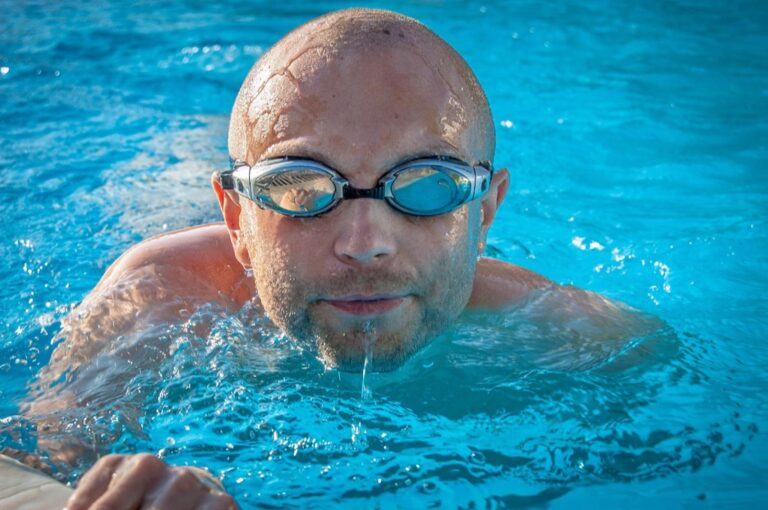
A huge part of water anxiety comes from sensory deprivation. Opening your eyes to a blurry, stinging underwater world is disorienting and can easily trigger panic. A good pair of goggles completely eliminates this problem.
Modern goggles like the Speedo Biofuse 2.0 are designed with comfort and a reliable seal as top priorities. Their soft, flexible gaskets conform to the shape of your face, preventing those distracting, anxiety-inducing leaks. More importantly, they provide a crystal-clear, wide field of vision that helps you feel oriented and aware of your surroundings.
Think of goggles as your personal window to the underwater world. They transform it from a murky, intimidating void into a clear, understandable space. This simple piece of equipment is often the key that unlocks a swimmer’s ability to put their face in the water calmly, which is a massive step forward.
Master Rhythmic Breathing Exercises on Land
The fear of not being able to breathe is at the core of most water anxiety. The good news is that you can start conquering this fear before you even touch the water. The secret is mastering rhythmic breathing.
On dry land, practice a simple, deliberate breathing pattern. Inhale through your mouth for a count of two, then exhale slowly and steadily through your nose and mouth for a count of four. The sensation should be like you’re gently blowing bubbles. Repeat this until the rhythm feels automatic and calming.
Once you’re comfortable, take this skill to the water’s edge. Hold onto the side of the pool, take a breath, and lower your face into the water while exhaling just as you practiced. Listen to the sound of your bubbles. Feel the calm of the long exhale. This exercise proves to your brain that you are in absolute control of your breath, even when your face is submerged.
Learn the Back Float to Trust Your Buoyancy
Many anxious swimmers operate under the false belief that they will sink the moment they stop trying to stay up. The back float is the perfect antidote to this fear. It is a profound lesson in trusting the water to do the work for you.
Start in waist-deep water, ideally with a coach or a trusted friend to support your head and back. Lean back slowly, letting your ears dip just below the surface—this is key for balance. Keep your lungs filled with air and push your hips up toward the surface. Your body wants to float; you just have to let it.
The initial instinct is to tense up and fight, which is exactly what makes you sink. The breakthrough comes when you consciously relax your neck, arms, and legs, and feel the water take your weight. Mastering the back float is a powerful moment that fundamentally changes your relationship with the water. It proves that the water is there to support you, not pull you under.
Practice Kicking with a TYR Classic Kickboard
After you’ve built some confidence with breathing and floating, it’s time to add movement. A kickboard is the ideal tool for this next step because it allows you to focus on one skill—propulsion—without the pressure of coordinating your arms and breath at the same time.
A sturdy, buoyant board like the TYR Classic Kickboard provides reliable support. Hold it with your arms extended and let your body float horizontally. Practice a gentle flutter kick, initiating the movement from your hips, not your knees. Your legs should be relatively straight with relaxed, floppy ankles.
This drill accomplishes two critical things at once. First, it builds the leg strength and muscle memory needed for efficient swimming. Second, it allows you to practice your rhythmic breathing while in motion, turning your head to the side to inhale and putting your face back in to exhale. It’s the perfect bridge from static drills to dynamic swimming.
Find a U.S. Masters Swimming Certified Coach
While self-teaching can get you started, the guidance of a professional coach is invaluable for overcoming deep-seated anxiety. A good coach provides a safe, structured environment and can identify and correct issues with a level of detail that a video or book never could.
When looking for an instructor, prioritize experience with adult learners and fearful swimmers. Certifications like those from U.S. Masters Swimming (USMS) are a strong indicator of quality, as these coaches are trained to work with adults of all skill levels and mindsets. They understand that teaching a fearful adult is completely different from teaching a fearless child.
A great coach acts as both a guide and a safety net. Their presence alone can lower your anxiety, giving you the confidence to try things you wouldn’t attempt on your own. Investing in a few lessons can accelerate your progress and help you break through plateaus that might otherwise cause you to give up.
Create a Consistent, Low-Pressure Practice Plan
Confidence is forged through consistent, positive experiences, not one-off acts of bravery. Trying to conquer your fear in a single, grueling session is a recipe for burnout and failure. A better approach is to commit to a regular, low-stress practice schedule.
Your goal isn’t to become an Olympian overnight. It’s simply to show up and spend a short amount of time in the water, ending each session on a positive note. Twenty minutes, two or three times a week, is far more effective than one miserable hour on a Sunday.
Design a plan that slowly builds on your successes. It might look something like this:
- Week 1: Focus solely on walking and comfortable breathing in the shallow end.
- Week 2: Introduce bobbing and blowing bubbles with your face in the water.
- Week 3: Practice assisted back floats and kicking with a kickboard.
Celebrate every small victory. Floating for three seconds longer than last time is a win. Putting your whole head under without panicking is a massive win. By breaking the journey into tiny, achievable steps, you build momentum and systematically replace fear with a well-earned sense of accomplishment.
Overcoming swim anxiety is a journey of rebuilding trust—trust in the water, and more importantly, trust in yourself. By taking it one step at a time with the right mindset and tools, you can move past your fear. The freedom, fitness, and pure joy waiting for you on the other side are well worth the effort.