8 Essential Adult Swim Training Aids for Backyard Lap Practice
Level up your backyard fitness with these 8 essential adult swim training aids. Enhance your stroke, build endurance, and master your technique. Shop the list now.
Trying to squeeze a productive lap workout into a standard backyard pool often feels like a frustrating cycle of endless, abrupt flip turns and wall-shoving. With the right training aids, however, a modest residential pool transforms into a high-performance training channel. Investing in specific, targeted gear allows swimmers to build endurance, refine stroke mechanics, and maintain high-intensity cardio without ever needing a local Olympic-sized lane.
Disclosure: As an Amazon Associate, this site earns from qualifying purchases. Thank you!
Turning a Small Backyard Pool Into a Lap Lane
Small backyard pools—whether they are modest inground setups or compact above-ground models—initially seem useless for serious lap swimming. The limited length means a swimmer spends more time turning and pushing off the wall than actually executing strokes. To bypass this spatial limitation, stationary training gear and targeted drag tools become absolute necessities to create resistance and mimic open-water conditions.
By utilizing the correct accessories, you can isolate specific muscle groups, correct stroke alignment, and generate a continuous swim experience. Rather than focusing on distance covered, backyard training shifts the emphasis to time under tension and stroke rate. The right gear mix turns a 15-foot pool into an endless swimming highway where technique and cardiovascular fitness can be pushed to their limits safely.
Swim Kickboard – Speedo Adult Team Kickboard
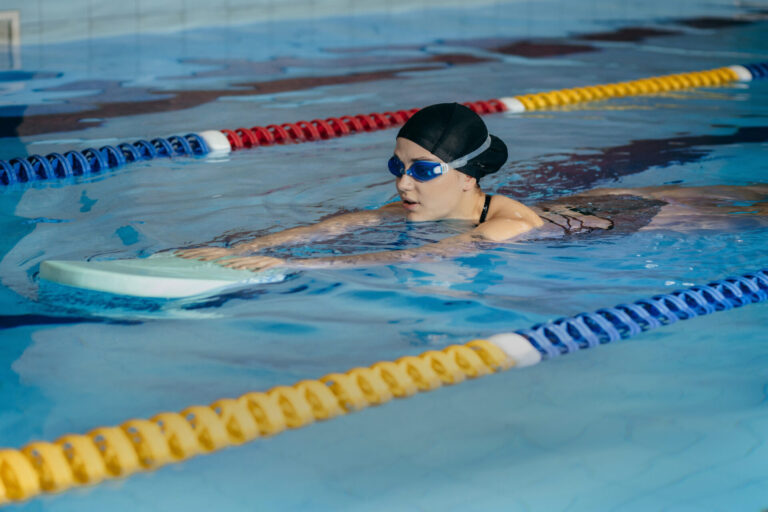
A quality kickboard shifts the entire workout focus to the lower body, building leg endurance and perfecting hip alignment without the distraction of arm strokes. In a backyard setup, where turns are frequent or a tether is in use, isolating the kick is crucial for maintaining a horizontal body position. Without a kickboard, swimmers often let their hips sink, which ruins stroke efficiency and drags the lower half down.
The Speedo Adult Team Kickboard stands out because of its high-density, closed-cell EVA foam construction, which resists water logging and maintains rigidity over seasons of heavy chlorine exposure. Its textured surface offers a reliable grip even when wet, and the ergonomic side scallops allow for natural hand placement that minimizes shoulder strain.
- Material: Textured EVA foam for grip and durability
- Dimensions: 19″ x 11.5″
- Stiffness: High rigidity to prevent bending under pressure
Before purchasing, keep in mind that this is a stiff, adult-sized board designed for serious training; it does not flex like cheap recreational pool noodles. It is perfect for swimmers looking to build lower-body power and core stability, but it is not ideal for those with acute shoulder injuries who require a more flexible, ergonomic support.
Pull Buoy – TYR Classic Foam Pull Float
A pull buoy does the exact opposite of a kickboard: it immobilizes the legs, allowing you to focus entirely on upper-body strength, rotation, and pull mechanics. In a compact pool, isolating your pull is one of the best ways to build shoulder and core strength because it removes the propulsion of the kick. It also assists with flotation, keeping the hips high in the water even at slower stroke tempos.
The TYR Classic Foam Pull Float features an asymmetric design with a 6-inch height that fits securely between the thighs or ankles without slipping. Its premium EVA foam composition provides just the right amount of buoyancy to keep your lower body level without lifting the hips too high, which can cause lower back strain.
- Sizing: 6-inch classic height
- Material: Non-chafing, closed-cell EVA foam
- Shape: Asymmetric contour for secure fit
Using a pull buoy requires strong core engagement to keep the legs from fish-tailing behind you, particularly when swimming on a stationary tether. This float is excellent for swimmers looking to isolate their catch and pull mechanics, but it is not recommended for those who struggle with basic core stabilization.
Hand Paddles – Strokemakers Swim Paddles
Hand paddles increase the surface area of your hands, creating extra resistance that builds upper-body power and instantly highlights flaws in your stroke. If your hand enters the water at an awkward angle or sweeps too wide, the paddle will catch the water incorrectly and pull your arm off-course. For backyard training, they are invaluable for developing a high-elbow catch and a clean, efficient entry.
Strokemakers Swim Paddles are the industry benchmark due to their flow-through design, which features strategically placed holes that allow for water feel while still providing massive resistance. The flexible medical-grade tubing straps can be customized for a precise, comfortable fit across the fingers and wrist.
- Sizes: 0 (small) to 5 (extra-large) for custom resistance
- Tubing: Adjustable, durable latex straps
- Design: Hydrodynamic contours to reduce shoulder stress
Sizing is critical here; buying paddles that are too large can quickly lead to shoulder strain or rotator cuff issues. Beginners should start with Size 0 or 1 to get used to the resistance, while seasoned swimmers can scale up to build raw power. These are not suited for individuals with existing shoulder pain or poor joint mobility.
Training Fins – Arena Powerfin Pro Swim Fins
Training fins are essential for developing a fast, compact kick while simultaneously increasing ankle flexibility and cardiovascular demand. In a small pool, they help you maintain momentum and body position, making it easier to focus on stroke technique without sinking. The added resistance forces the leg muscles to work harder, burning more calories in a shorter amount of time.
The Arena Powerfin Pro Swim Fins are engineered with a short, stiff blade made of 100% silicone, which prevents the blistering and chafing common with rubber fins. The open-heel design allows for maximum ankle joint flexibility, while the side rails and customized bottom grip ensure high-speed propulsion and stability.
- Material: 100% long-lasting silicone
- Blade Length: Short, high-frequency design
- Heel Type: Open-heel for maximum ankle mobility
Because these fins are made of heavy silicone, they feel weightier in your swim bag but provide unmatched durability against pool chemicals. They are designed for a tight, secure fit to prevent slipping, so sizing up is recommended if you fall between sizes. These are perfect for intermediate to advanced swimmers, but absolute beginners might find the stiff blade taxing on the calves initially.
Swim Snorkel – FINIS Swimmer’s Snorkel
A center-mount swim snorkel eliminates the need to rotate the head to breathe, allowing you to focus entirely on body alignment, head position, and stroke symmetry. When swimming in a small pool—especially on a tether—rotating to breathe can disrupt your balance and cause your hips to sway. The snorkel keeps your gaze fixed downward, promoting a neutral spine and a more efficient catch.
The FINIS Swimmer’s Snorkel is the original center-mount training snorkel, featuring a hydrodynamic design that stays secure even during high-intensity efforts. The adjustable head bracket accommodates swim caps and goggles easily, while the one-way purge valve makes clearing water simple and quick.
- Mount Type: Center-mount bracket
- Valve: One-way purge valve for easy clearing
- Mouthpiece: Medical-grade silicone
There is a brief learning curve when using a snorkel, as it requires breathing exclusively through your mouth while water surrounds your nose. Nose clips can be a helpful companion accessory if you struggle with water entry. This tool is a must-have for anyone refining their stroke alignment, but it may cause mild anxiety for those who are uncomfortable with restricted breathing.
Swim Tether – StretchCordz In-Water Tether
The swim tether is the single most important tool for turning a small backyard pool into an endless lap lane. By anchoring yourself to a fixed point, you can swim continuously for miles without ever touching a wall or executing a turn. This provides a steady-state cardio workout that mimics open-water swimming, making it highly effective for triathlon training.
The StretchCordz In-Water Tether utilizes high-quality safety-cord tubing that resists degradation from UV rays and pool chemicals. The comfortable, adjustable waist belt fits securely without digging into your skin, and the durable mounting strap can be easily secured to ladder rails, posts, or anchors.
- Cord Length: 10-foot durable safety cord
- Waist Belt: Adjustable up to 44 inches
- Resistance: Heavy-duty rubber tubing
When using a tether, you must be aware of the “snapback” effect if you swim too close to the anchor point; maintaining a steady, controlled tempo is key. It requires a solid anchor point and a pool depth that prevents your knees from scraping the bottom. This is the ultimate tool for dedicated backyard lap swimmers, but it is not ideal for casual splashers looking for a low-effort pool toy.
Waterproof Smartwatch – Garmin Swim 2 GPS
When swimming stationary on a tether, traditional lap counting is useless because you never actually turn. A dedicated swim smartwatch solves this by tracking your stroke rate, heart rate, time under tension, and overall workout duration. It keeps you honest about your effort levels and allows you to structure interval training without relying on a wall clock.
The Garmin Swim 2 GPS is purpose-built for swimmers, featuring advanced pool and open-water profiles that track metrics like SWOLF, stroke count, and distance. It has a crystal-clear display that is highly visible under water and a slim profile that does not catch the water or interfere with your wrist entry.
- Tracking Metrics: SWOLF, stroke rate, heart rate, pace
- Water Rating: 5 ATM (50 meters)
- Battery Life: Up to 7 days in smartwatch mode
While this watch offers GPS for open-water use, in a small backyard pool, you will primarily rely on its “Pool Swim” manual lap function or “Drill Logging” to track stationary efforts. It requires syncing with the Garmin Connect app to analyze your progress over time. It is an invaluable investment for data-driven swimmers, though it may be overkill for those who simply want to swim for relaxed cardio.
Swim Goggles – Speedo Vanquisher 2.0 Mirrored
A dependable pair of swim goggles is non-negotiable for protecting your eyes from chlorine and ensuring clear underwater vision during long sessions. In a backyard pool, shifting sunlight, shadows, and pool steps present unique visual obstacles that require excellent peripheral vision and glare protection. Poorly fitting goggles that leak or fog up can ruin a workout faster than almost any other gear failure.
The Speedo Vanquisher 2.0 Mirrored goggles are widely regarded as the gold standard for their low-profile inner eye fit and cushioned silicone seals that prevent leaks. The mirrored lenses significantly reduce glare from the sun reflecting off the water surface, and they offer built-in anti-fog and UV protection.
- Lens Type: Mirrored with UV/Anti-fog protection
- Fit: Inner eye cushioned silicone seals
- Nosepieces: 4 interchangeable nose bridges for custom fit
The mirrored coating is perfect for sunny outdoor backyard pools, but it might feel a bit too dark if you prefer to swim in the late evening or under poor pool lighting. Take the time to swap out the interchangeable nose bridges to find the perfect seal before your first swim. These are ideal for any swimmer demanding a leak-free, comfortable fit, but they are not designed for those who prefer the wider view of a swim mask.
How to Safely Install a Stationary Swim Tether
Installing a stationary swim tether correctly is the difference between a smooth, continuous workout and a dangerous equipment failure. The primary goal is to find an anchor point that is sturdy enough to withstand constant, dynamic pulling forces without budging. Ideal anchor points include pool ladder handrails, heavy-duty fence posts, or dedicated brass deck anchors installed directly into the pool surround. Avoid flimsy pool furniture, plastic skimmer covers, or lightweight handrails that could bend or snap under tension.
The height of the anchor point significantly affects your body position in the water. A low anchor point—close to water level—tends to pull your hips down, making it harder to maintain a horizontal profile. Elevating the anchor point slightly, about 1 to 2 feet above the water line, provides a neutral pull that helps keep your legs closer to the surface. Ensure the cord is long enough to keep you at least 6 feet away from the pool wall to prevent accidentally kicking or hitting the coping during your workout.
Maximizing Swim Workouts in Small Pool Spaces
Without the physical boundaries of lane lines and walls, swimming in a small pool requires a shift in how you structure your workouts. Instead of swimming “laps,” design your sessions around time-based intervals or stroke counts. For example, a set of 5×3 minutes at a moderate effort with 30 seconds of rest mimics a standard 200-yard interval set. Using a smartwatch or a visible deck clock is essential for keeping track of these time intervals accurately.
Incorporate different training aids throughout your session to break up the monotony of stationary swimming and target different energy systems. Start with a warm-up using a snorkel to establish balance, switch to hand paddles and a pull buoy to build upper-body strength, and finish with a high-intensity fin set to elevate your heart rate. This variety not only keeps your mind engaged in a limited space but also ensures a balanced, full-body workout that rivals any public pool session.
Caring for Your Training Gear After Every Swim
Chlorine, salt, and direct sunlight are the absolute enemies of swim training gear, causing plastics to degrade, elastic to snap, and foam to crumble. To extend the lifespan of your investment, rinse every piece of equipment in cool, fresh tap water immediately after every swim. This simple step washes away residual pool chemicals and minerals before they can eat into the materials or dry out the silicone seals.
Once rinsed, air-dry your gear in a shaded, well-ventilated area away from direct sunlight, which can warp plastics and degrade rubber straps. Avoid leaving your training aids sitting in a damp, closed gear bag, as this creates a breeding ground for mold, mildew, and unpleasant odors. For long-term storage during the off-season, ensure everything is completely dry, and store your gear in a cool, climate-controlled space to prevent the rubber and silicone components from dry-rotting.
With the right selection of training aids and a solid stationary tether setup, your backyard pool becomes a highly effective arena for physical fitness and stroke refinement. By focusing on time under tension and utilizing gear that isolates and challenges your body, you can achieve elite-level swim workouts just steps from your back door. Gear up correctly, set your routine, and enjoy the convenience of continuous lap practice on your own schedule.