How to Shock a Green Pool Back to Blue Fast
Turn your cloudy water clear with these 9 essential supplies to shock a green pool back to blue. Follow our expert guide to restore your backyard oasis today.
Stepping out into the backyard only to find the pool has transformed into a murky green swamp is a frustrating rite of passage for many homeowners. Reclaiming a pool from a severe algae infestation requires a systematic approach rather than just throwing random chemicals at the problem. With the right gear and a clear plan of action, any pool owner can restore their water to crystal-clear blue without hiring an expensive professional service.
Disclosure: As an Amazon Associate, this site earns from qualifying purchases. Thank you!
Why Pools Turn Green and How to Prep for Treatment
Algae blooms occur when sanitizer levels drop too low, allowing microscopic spores to multiply rapidly in warm sunlight. Poor water circulation, heavy rainstorms, and high phosphate levels act as fuel for this sudden growth. Once the algae takes over, it turns the water into a cloudy, green soup that is unsafe for swimmers.
You cannot simply dump shock into a dirty pool and expect immediate results. Large organic debris like leaves, twigs, and bugs must be completely removed first because they consume chlorine and drastically lower the chemical’s effectiveness against algae. Removing this physical debris clears the path for the chemical treatment to target the algae directly.
Before applying any chemicals, the pool walls must be thoroughly brushed to break the algae’s protective biofilm. This physical agitation suspends the algae in the water, making it far more vulnerable to the incoming chlorine shock. The filtration system must also be fully operational, as it will do the heavy lifting of clearing the dead algae from the water over the coming days.
Pool Test Kit – Taylor Technologies K-2006
A pool owner cannot treat water chemistry issues effectively without highly accurate measurements of the pool’s current state. Standard test strips are often inaccurate, especially when water parameters are wildly out of balance, making a professional-grade liquid test kit essential for identifying exact pH, alkalinity, and stabilizer levels. This kit provides the precise baseline readings needed to calculate exactly how much chemical treatment is required to reclaim the water.
The Taylor Technologies K-2006 FAS-DPD kit is widely considered the gold standard for residential pool care because of its high-precision liquid reagents. Unlike basic kits that rely on subjective color-matching for chlorine, this kit uses a titration method where color changes from pink to clear to measure free chlorine in precise increments. It can accurately measure free chlorine levels up to 20 ppm or higher, which is critical when tracking the high sanitizer levels required during a shock treatment.
Liquid reagents have a limited shelf life and must be stored in a cool, dry place out of direct sunlight to maintain their chemical accuracy. While this kit has a minor learning curve with its drop-counting testing method, the included color-coded instruction card makes the process straightforward for any homeowner. This kit is indispensable for those dealing with a persistent green algae outbreak, though it may be more testing power than a casual owner needs for basic weekly checks.
- Test types: Free and combined chlorine (FAS-DPD), pH, acid/base demand, total alkalinity, calcium hardness, and cyanuric acid (stabilizer).
- Reagent size: 0.75-ounce bottles.
- Accuracy range: Measures free chlorine in increments of 0.2 ppm or 0.5 ppm.
Pool Brush – Lalapool Heavy Duty Algae Brush
Algae clings tenaciously to pool surfaces, forming a slimy outer layer that resists chemical penetration. Vigorous brushing physically breaks this barrier, exposing the living algae cells directly to the sanitizer. Without this step, chlorine will only kill the outer layers of the bloom, leaving the roots to quickly regenerate.
The Lalapool Heavy Duty Algae Brush features an 18-inch wide aluminum back and handle paired with stiff stainless steel bristles designed specifically for tough scraping. The heavy-duty metal reinforcement prevents the brush head from bending or snapping when applying maximum downward pressure on stubborn black or green algae spots. Its curved edges make it easy to clean tight corners and steps where algae loves to hide.
Steel bristles are highly abrasive and must only be used on concrete, plaster, or gunite pools. Do not use steel bristles on vinyl liners or fiberglass pools, as they will tear or scratch the surface; owners of those pools should opt for a nylon-bristled version of the same brush. This tool connects to any standard 1.25-inch telescopic pole, making it an easy addition to an existing maintenance setup.
- Width: 18 inches.
- Bristle material: Stainless steel (not for vinyl or fiberglass).
- Connection type: Standard EZ-clip connection for telescoping poles.
Leaf Rake – Pro-Tuff 18-Inch Professional Net
Heavy debris resting on the pool floor acts as a constant food source for bacteria and rapidly consumes the chlorine needed to kill algae. A high-capacity leaf rake is required to scoop large volumes of organic material out of the pool before chemical treatment begins. Standard flat skimmer nets are useless for this task, as they lack the depth to hold heavy wet debris.
The Pro-Tuff 18-Inch Professional Net is built around a rigid, aluminum alloy frame that will not bend or twist under the weight of wet, heavy leaf piles. Its deep, durable nylon mesh bag has a tapered edge that easily glides along the pool floor, scooping up debris rather than pushing it around. The plastic scoop lip is replaceable, which extends the overall life of the frame.
Unlike cheap plastic nets that crack after one season of sun exposure, this commercial-grade rake is designed to withstand years of heavy use. This tool is perfect for pools surrounded by deciduous trees, though users should ensure their telescoping pole is sturdy enough to lift the heavy loads this net can scoop. It is a highly necessary investment for any pool owner dealing with heavy seasonal cleanups.
- Frame width: 18 inches.
- Bag material: Heavy-duty double-stitched nylon mesh.
- Warranty: Lifetime replacement guarantee on the frame.
Chlorine Shock – HTH Super Shock Treatment
Reclaiming a green pool requires raising the free chlorine level to a breakpoint concentration that oxidizes all organic matter and kills the algae. Standard chlorine tablets dissolve too slowly to achieve this, making fast-acting granular shock necessary to deliver a massive spike in sanitizer. Without this rapid elevation of free chlorine, the algae will continue to reproduce faster than the sanitizer can kill it.
HTH Super Shock Treatment utilizes calcium hypochlorite (cal-hypo) at a 56.5% concentration, providing a powerful sanitizing boost without adding cyanuric acid (CYA) to the water. This is crucial because high CYA levels lock up chlorine, rendering future treatments ineffective and forcing a partial water drain. This granular formula dissolves rapidly, releasing its active chlorine immediately to begin oxidizing the algae.
Cal-hypo must be dissolved in a bucket of water before being poured into the pool to prevent bleaching vinyl liner surfaces or causing temporary cloudiness. Because it raises calcium levels slightly, it may not be suitable for areas with extremely hard tap water, where sodium dichlor or liquid chlorine might be preferred. It remains the ultimate choice for rapid, aggressive algae eradication in most standard backyard pools.
- Active ingredient: Calcium Hypochlorite (56.5%).
- Available chlorine: 53%.
- Packaging: 1-pound easy-open bags.
pH Decreaser – In The Swim Sodium Bisulfate
Chlorine shock loses its sanitizing power when the pool’s pH is too high. At a pH of 8.0, chlorine is only about 30% effective, meaning you must lower the pH to a slightly acidic or neutral level before shocking to maximize the chemical’s killing power. Bringing the water into the proper range ensures that the shock works at peak efficiency.
In The Swim Sodium Bisulfate is a granular pH reducer that is significantly safer and easier to store than liquid muriatic acid. It dissolves quickly when broadcasted over the deep end of the pool, lowering both pH and total alkalinity to bring the water into the optimal chemical sweet spot. This granular form eliminates the risk of dangerous liquid spills and corrosive fumes during transport and storage.
Because it is a dry acid, users must handle it with care, wearing eye protection and gloves to prevent skin irritation. It requires a few hours of pool circulation to fully blend and show accurate results on a test kit before adding shock. This is the ideal acid adjuster for pool owners who prefer not to handle hazardous liquid acids in their backyard.
- Active chemical: 93.2% Sodium Bisulfate (Dry Acid).
- Form: Granular.
- Dosage guide: Approximately 1 pound per 10,000 gallons to lower pH by 0.2.
Algaecide – Clorox Pool&Spa Green Algae Eliminator
While chlorine does the heavy lifting of killing algae, an algaecide acts as a critical secondary line of defense. It penetrates the cellular walls of the algae, weakening the organism and allowing the chlorine shock to finish the job faster and more efficiently. Using an algaecide in tandem with shock is especially helpful for severe blooms that have resisted initial chlorine treatments.
Clorox Pool&Spa Green Algae Eliminator is a highly effective non-foaming copper-based formula that targets stubborn green algae strains. It does not create unsightly foam on the surface of the pool, which is a common issue with cheaper quaternary ammonium algaecides. The copper ions remain active in the water for days, helping to prevent the return of new spores.
Because it contains copper, overusing this product can lead to metal staining on plaster walls or turn blond hair green if the water chemistry is not properly balanced. It should be used strictly as a supplemental treatment after shocking, rather than a primary sanitizer. This product is best for owners facing a severe, persistent bloom that chlorine alone is struggling to clear.
- Formula type: Copper-based algaecide.
- Compatibility: All pool types, including saltwater systems.
- Foam profile: Non-foaming.
Water Clarifier – Robarb Super Blue Clarifier
Once the chlorine and algaecide have successfully killed the algae, the pool water will transition from a swampy green to a cloudy, milky white. This cloudiness consists of millions of microscopic dead algae cells that are too small for the pool filter to catch on its own. A water clarifier is needed to help the filtration system capture these tiny suspended particles.
Robarb Super Blue Clarifier uses a highly concentrated polyelectrolyte formula to attract these tiny floating particles, binding them together into larger clumps. Once clumped, these particles become large enough for the pool’s sand, cartridge, or D.E. filter to easily trap and remove from circulation. This formula is highly concentrated, requiring only a small dose to clear thousands of gallons of water.
Clarifiers must be used in moderation; adding too much can actually reverse the clumping process and cause long-term cloudiness. The pool filter must run continuously for 24 to 48 hours after application to effectively clear the water. This clarifier is a must-have for anyone looking to accelerate the final polishing stage of the water reclamation process.
- Chemical base: Organic polymer.
- Dosage: 1 ounce treats 5,000 gallons.
- Compatibility: Safe for all filter types (sand, cartridge, D.E.).
Pool Vacuum – Pentair R201276 ProVac Linear
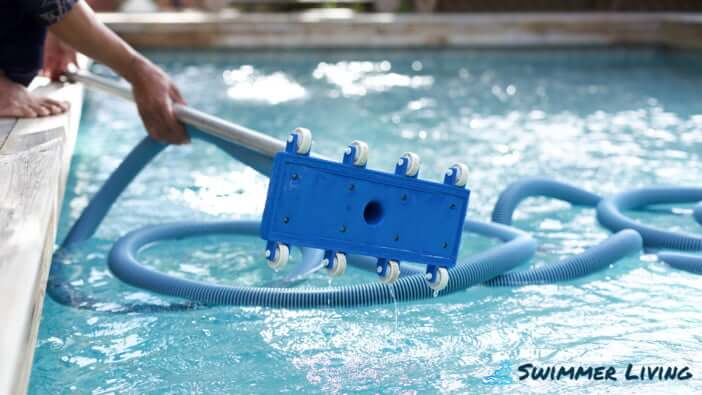
Heavy debris and dead algae clumps will eventually settle to the bottom of the pool floor, forming a layer of grey silt. A manual vacuum is required to physically remove this waste from the pool system, rather than letting it recirculate through the filter. Vacuuming to waste is the fastest way to get this organic material out of the pool for good.
The Pentair R201276 ProVac Linear vacuum head is designed for plaster and concrete pools, featuring a 14-inch wide suction channel and adjustable polyurethane wheels. Its heavy-weighted design prevents the vacuum head from floating off the pool floor, ensuring a consistent seal and maximum suction power. The flexible body contour allows it to navigate curves and transitions on the pool floor easily.
This is a manual vacuum head that must be connected to a standard pool hose and telescoping pole, meaning it relies on the pool’s suction line or skimmer for suction. It is not a robotic vacuum, so manual labor is required to clean the pool floor. It is ideal for pool owners with strong suction lines who need a durable, reliable tool to clean up heavy sediment.
- Suction width: 14 inches.
- Wheel type: Polyurethane with ball bearings.
- Hose compatibility: Fits 1.5-inch vacuum hoses.
Filter Cleaner – Pleatco FilterWash Tablets
After filtering out tons of dead algae, the pool’s filter cartridge or sand bed will become choked with oils, organic scale, and debris. Running a dirty filter drastically reduces water flow and filtration efficiency, halting the clearing process. Cleaning the filter during and after the shocking process is essential to maintain proper water circulation.
Pleatco FilterWash Tablets are fast-acting, effervescent tablets engineered specifically to penetrate deep into the fibers of cartridge filters or D.E. grids. They release built-up oils and chemical residue without using harsh mineral acids that can degrade the filtration fabric over time. This targeted cleaning restores the filter’s flow rate and extends the life of the cartridge.
Using these tablets requires removing the filter cartridge from its canister and soaking it in a bucket of water with the dissolved tablet for at least 25 minutes. A thorough rinse with a garden hose is necessary after soaking to remove all loosened debris before reinstalling the filter. It is an essential maintenance step to restore system pressure and keep water flowing smoothly during the shocking process.
- Form: Effervescent tablet.
- Target contaminants: Body oils, sunscreen, algae, scale.
- Package options: Available in single or multi-packs.
Step-by-Step Instructions to Shock Your Pool
Start by manually removing all large leaves, twigs, and organic debris using the leaf rake. Next, adjust the pH to between 7.2 and 7.4 using the pH decreaser, as this ensures your chlorine shock operates at maximum strength. Brush the pool walls and floor vigorously with the algae brush to disrupt any protective biofilm.
Calculate the pool volume to determine the required dosage of HTH Super Shock; for a dark green pool, a triple-shock dose (3 pounds per 10,000 gallons) is often necessary. Dissolve the granular shock in a bucket of pool water and pour it around the perimeter of the pool at dusk to prevent the sun’s UV rays from burning off the chlorine. Turn the pool pump to “recirculate” or “filter” and run it continuously.
After 12 to 24 hours of circulation, add the green algaecide and the water clarifier to help bind the dead algae particles together. Run the filter continuously, monitoring the filter pressure gauge closely, and use the filter cleaner or rinse the cartridge when pressure rises 8-10 psi above normal. Once the water turns cloudy-blue, vacuum the settled sediment directly to waste, then rinse or deep clean the filter one final time.
How to Maintain Balanced Water After Shocking
Reclaiming a blue pool is a major victory, but keeping it that way requires consistent, proactive maintenance. Use your liquid test kit at least twice a week to monitor free chlorine, pH, and total alkalinity, adjusting chemicals immediately when they drift out of range. Maintaining a baseline free chlorine level of 2 to 4 ppm will prevent microscopic algae spores from ever taking root again.
Watch your cyanuric acid (CYA) levels closely, keeping them between 30 and 50 ppm to protect your chlorine from sunlight degradation without causing “chlorine lock.” Ensure your pool pump runs for at least 8 to 12 hours a day during the summer to maintain adequate water turnover and filtration. Clean the skimmer baskets daily and brush the pool walls weekly to keep circulation pathways clear of debris and biofilm.
Conclusion
Turning a green pool back to blue requires patience and the right tools, but the results are highly rewarding. Armed with these nine essential supplies, you can transform your backyard swamp back into a safe, crystal-clear swimming oasis.