
6 Best Stereo Receivers For Pontoon Boats For Audiophiles
Upgrade your pontoon’s audio with these six top-tier stereo receivers. We analyze durability, sound quality, and connectivity for the true marine audiophile.
There is nothing quite like anchoring your pontoon in a quiet cove as the sun dips below the horizon, provided your music sounds as crisp as the evening air. Transforming your deck into a high-fidelity soundstage requires more than just tossing a few speakers onto the furniture. Selecting the right marine-grade stereo receiver is the foundational step toward achieving concert-level clarity on the water.
Disclosure: As an Amazon Associate, this site earns from qualifying purchases. Thank you!
Key Considerations for Pontoon Audio Systems
When outfitting a pontoon, you aren’t just fighting ambient noise; you’re battling an open-air environment that loves to swallow sound frequencies. Unlike a car, a pontoon has no roof or side panels to trap bass, meaning you need a head unit that supports robust external amplification and advanced equalization settings.
You must also prioritize IP ratings, which indicate how well the electronics resist water intrusion and salt spray. Don’t just look for "water-resistant"; look for true marine-grade certification that ensures the internal circuit boards are conformal-coated against moisture and corrosion. Finally, consider the user interface—you want large, backlit buttons or a crisp display that remains readable even under the harsh glare of midday sun.
Fusion Apollo MS-RA770: Top Audiophile Choice


If you demand the absolute best in sound processing and digital integration, the Fusion Apollo MS-RA770 is your gold standard. This unit features Digital Signal Processing (DSP) that allows you to customize the audio profile based on your specific speaker placement, ensuring every frequency hits exactly where it should.
Its touchscreen interface feels remarkably intuitive, almost like a high-end smartphone mounted to your helm. For the audiophile who wants multi-zone control and seamless Wi-Fi streaming without sacrificing signal quality, this is the definitive choice. If you are building a top-tier system, skip the compromises and go straight for the Apollo.
JL Audio MediaMaster 105: Premium Sound Quality

JL Audio has built a reputation on high-fidelity performance, and the MediaMaster 105 lives up to that legacy by prioritizing sonic purity above all else. This receiver offers a clean, low-distortion output that makes your favorite tracks sound nuanced and detailed rather than just loud.
The interface is rugged and straightforward, designed specifically for those who want to adjust their soundstage while keeping their eyes on the water. It is an investment piece, certainly, but for the listener who can distinguish between average and elite clarity, the MediaMaster 105 is worth every penny. You buy this unit when you want your pontoon to sound like a high-end home theater.
Rockford Fosgate PMX-8BB: Best Marine Power

The Rockford Fosgate PMX-8BB is a beast of a unit, designed for those who want to push their marine speakers to their absolute limit. This is a "hide-away" style receiver, meaning the main brain is tucked safely under the console while you control everything via a sleek, mounted remote interface.
Because it is designed for heavy-duty output, it pairs perfectly with high-wattage amplifiers and subwoofers. If your goal is to be the loudest boat in the sandbar without sacrificing the punch of your bass, this is the receiver for you. It isn’t for the casual listener; it’s for the enthusiast who wants raw, unadulterated power.
Kenwood KMR-M332BT: Best Value Connectivity
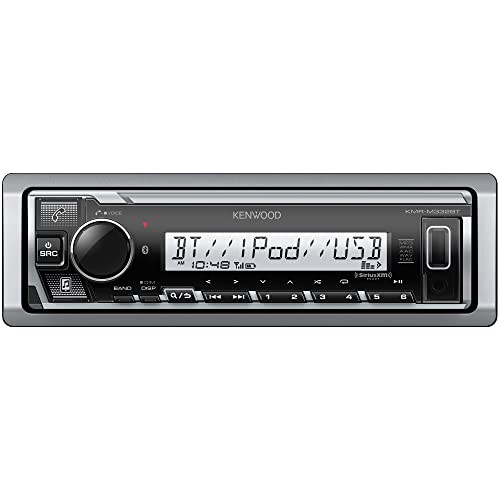
Not everyone needs a professional-grade studio setup to enjoy a day on the lake, and the Kenwood KMR-M332BT hits the sweet spot for most boaters. It provides excellent Bluetooth connectivity and a user-friendly interface that lets you stream your playlists without any technical headaches.
While it lacks some of the deep-dive audio tuning found in more expensive units, it offers incredibly reliable performance at a price point that leaves room in your budget for better speakers. This is the perfect "set it and forget it" receiver for a family pontoon. It’s a workhorse that delivers exactly what you need with no unnecessary fluff.
Clarion CMS4 Marine: Best Weather Resistance

Clarion has long been a leader in marine electronics, and the CMS4 is engineered to survive the most punishing environments. Its "black box" design keeps the sensitive electronics away from the elements, while the controller is built to withstand direct spray and even submersion.
This receiver is ideal for pontoon owners who leave their boat in the water all season or frequent brackish, high-humidity environments. If you are tired of replacing head units every two years due to corrosion, the CMS4 provides the peace of mind you need. It is the ultimate choice for durability-focused boaters.
Wet Sounds WS-MC-2: Best Compact Performance

Sometimes space on the helm is at a premium, and that is where the Wet Sounds WS-MC-2 shines. Despite its compact, gauge-style form factor, it packs a surprising amount of punch and features a high-contrast display that is easy to read even with polarized sunglasses on.
It’s surprisingly powerful for its size and integrates beautifully with Wet Sounds’ wider ecosystem of marine speakers and amps. This unit is perfect for smaller pontoons or owners who want a clean, minimalist look at the helm. It proves that you don’t need a massive console to get high-quality audio.
Essential Wiring and Grounding for Pontoons
Wiring is the silent killer of marine audio systems; if you don’t use high-quality, tinned-copper marine-grade wire, you are inviting corrosion into your system. Always use heat-shrink butt connectors to seal your connections, as standard electrical tape will fail within a single season.
Proper grounding is equally critical to prevent the dreaded "engine whine" that can ruin your music. Ensure your ground wire is the same gauge as your power wire and run it directly to a common ground bus bar or the battery negative terminal. A solid, clean ground is the secret to a noise-free, audiophile-grade experience.
Optimizing Speaker Placement for Clear Audio
On a pontoon, speaker placement is about creating a "sound bubble" rather than just blasting noise into the distance. Mount your primary speakers at ear level whenever possible, and ensure they are angled toward the center of the seating area.
Don’t be afraid to utilize under-seat mounting for subwoofers to create a resonant chamber, but always ensure they are in a sealed or ported enclosure to protect them from gear storage. By focusing on dispersion rather than raw volume, you can achieve a rich, immersive sound that remains clear even while cruising at speed.
Protecting Your Marine Receiver From Elements
Even the most rugged marine receiver will last longer if you take proactive steps to shield it from the sun and rain. A simple, hinged splash cover over your head unit can prevent direct water intrusion during heavy storms or wash-downs.
In the off-season, consider using a breathable, moisture-wicking cover for your entire helm area to prevent condensation buildup. If you are storing your boat for the winter, a quick spray of a corrosion-inhibitor on the rear connections can save you from a major headache come springtime. Taking care of the small details now ensures your music sounds perfect all summer long.
Investing in a quality stereo receiver is the difference between background noise and a truly immersive aquatic experience. By matching your specific needs for power, durability, and sound quality to the right head unit, you ensure your pontoon remains the heart of every weekend adventure. Choose your gear wisely, wire it with care, and enjoy the perfect soundtrack for your time on the water.